
Alchemy and Chapbooks
Alchemy and Words
Defined as “a seemingly magical form of transformation or creation,” I’m prepared to claim that alchemy is often involved in the development of published literature. If one dips into human records, it becomes clear that some enchantment around hidden skills is involved at several points in the history behind an author’s dream of holding a book or chapbook that they created. You only have to ask which came first: the book, the paper within the book, or the process of writing things down? For, historically, every culture around the world began with oral histories.
There is no surviving evidence of who first thought of making a permanent physical record of anything, whether we’re talking about head counts, stories, dreams, songs, dates, official titles, or monetary transactions. It’s fact that our ancestors possessed far better memories than modern humans, and orality served them very well. Writing developed in three separate regions of the globe—Mesopotamia in 3200 BC, China in 1200 BC, and Mesoamerica in 300 BC. A written form of language began to emerge as people settled in cities and those in power realized they needed a way to prove transactions that had been completed or were yet to be completed. While that would seem to kick the magic right out of writing for most modern-day literate folk, by keeping training to read and write to a very few scribes in ancient times, the institutions governing ancient society maintained their aura of mystery and divination around records for who paid their taxes and who neglected to do so. The recording of anyone’s myths, legends, and history would not come into play until much later.
The Origin of the Chapbook
There is little agreement on the date of the origin of chapbooks, with estimates ranging from the 16th to the 19th century. Not only is this confusing but it ignores the much longer and important path that chapbooks depended upon to find their place in the literary world. In bygone eras, alchemists searched for the philosopher’s stone believing it could turn any metal into gold, or cure diseases, or grant eternal life. I’m certainly not talking about that sort of magic, but I do believe there’s a certain thaumaturgy or illusion involved in creating chapbooks. Still, in talking about the emergence of the chapbook itself, we need to look into what it takes to make one. First, you need the ability to record something – a form of writing – and then a medium to preserve that, in this case some variety of paper.
Inventing Paper
The mere mention of the word paper offers us clues about the origin of that product in 3000 BC. The Babylonians and Egyptians first developed a writing surface from papyrus palms by laying strips cut from its pithy stem side by side and overlapping to create sheets. The Greeks and Romans also used papyrus leaves to record contractual agreements. Of course, this wasn’t the only way that humans kept written records. The bark from certain trees, wooden slats, and leather or parchment were also used to make records, while wax was used by Roman scribes to record less important data. Certain stones in buildings were carved with titles and dates. However, like reading and writing themselves, paper wasn’t generally available to the masses. Even the great leaders employed scribes who kept track of important events and arrangements
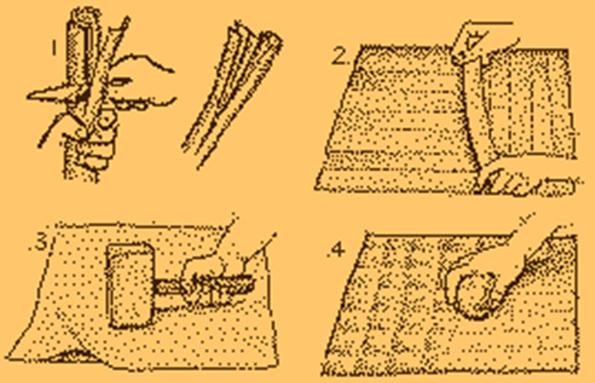
The process of making paper from papyrus
It was the Chinese who first ground together textile fibres, hemp, and mulberry bark to make paper
in the 2nd century. Indeed, their process was lent a touch of allure. They kept that method a highly guarded secret until it eventually spread to Korea and Japan in 610 AD. Their process remained an oriental art until the Arabs learned about it in the 8th century. In fact, the first manufacturing of paper in Europe didn’t occur until 1144 near Valencia, Spain. Italy followed in the 13th century with a paper mill (that still exists) at Fabriano in 1276. The paper produced in Europe was made from rags in mills powered by wind or water. Their power source severely limited to where those mills could be located. Around this time, the sizing of paper with animal glue was invented in Italy. A German paper mill appeared in 1389, followed by several others across Europe in the 15th century.
Needless to say, for centuries, books and chap-books were rare and expensive items in part due to the scarcity of the necessary fibre from rags – cotton being the most preferred – to make the paper. The invention of the Hollander Beater machine in 1680 increased the availability of fibres from plants. At the end of the 18th century, chlorine bleaching was introduced and in the 19th century the sizing of paper switched from animal products to aluminum sulphate and rozin. Finally, in 1845, Friedrich Gottlob developed a process for using tree fibresto make paper. In modern times, it’s become quite common for artists, school children, and other ordinary folk to explore making paper by hand.
The History of Chapbooks
Chapbooks are bite-sized compared to the published book. You may think their name came from chapters, but it actually derives from the Chapmen or itinerant vendors who sold them on the streets in Europe for a penny. Their low cost made it possible for almost anyone to own them. When full-sized books became available to the public after the invention of the Guttenburg press in 1450, they were large and expensive due to the shortage of fibre for paper. The function of books in spreading knowledge appealed to the rich, who were educated and able to read them. Large houses often had a room called the library, whereas poorer classes carried a chapbook in their pocket. With the increased availability of paper and printed materials in the 16th century, even the working class could afford an 8- or 12-page, pocket-sized booklet, which often recorded folk songs. Chapbooks often supported community gatherings, to celebrate with songs. Others offered rogue adventures that thrilled their audiences. This was rather magical. In addition, chapbooks in those early days were heavily illustrated with woodcuts, which also improved their appeal to the masses.
Chapbooks further contributed to their mystique by the late 18th century, often reflecting the Enlightenment spirit spreading ideas like those in Thomas More’s The Rights of Man from 1791. It meant they became a source for developing social and political awareness. The mindset of ordinary folk was changed by the revelation of ideas that empowered them, those who’d previously been under the thumb of the rich and powerful rising up to resist their segregation.
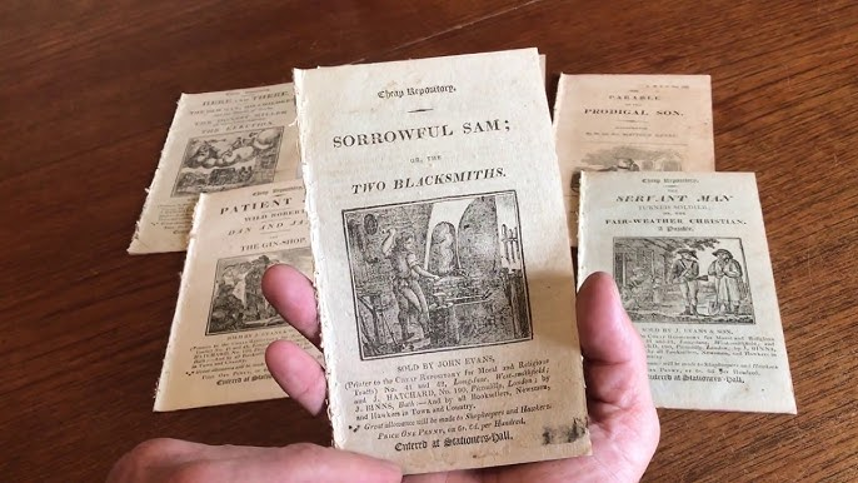
English chapbook collection with woodcut title pages. Circa 1790-1810
Photo credit: Brian DiMambro Rare Books & Antique Maps
During the 16th and 17th centuries, the working class in Europe gradually became more literate, in part due to charity schools created for the poor. The greater availability of paper and printing facilities also helped. The growing popularity of reading meant literacy was no longer the pursuit of the rich. Still, religious chapbooks with a sanctimonious tone in the 19thcentury offered a spiritualism that didn’t appeal to everyone, just when ease of sourcing materials allowed printers to produce cheaper books. However, the “Arts and Crafts Movement” led to a resurgence of the chapbook in the late 19th and early 20th centuries through its emphasis on the importance of hand-crafted items. That group of artists and designers believed mass-produced products led to an alienation of human touch and sterility of thought; so, they urged a general return to traditional methods of production for all things.
There was also a huge shift in genre for chapbooks. While they had begun by recording folk songs and heroic tales, the chapbook now offered the poetry of modernists. In addition, the invention of the typewriter, staplers, and mimeograph machines, along with the widespread availability of paper and card stock made it possible for artists and poets to produce chapbooks themselves. Chapbooks were especially popular with the Beat Poets of the 1950s, who circumvented official channels trying to control their public voice. They became activists, taking their chapbooks along with them to sell at public readings or standing on a street corner to sell their literary wares. Though most refrained from using soapboxes, they brought all the tricks learned through advertising from the 1940s onwards into selling their work.
The Call for Chapbooks
If you are not open to self-publishing, you know that the journey from creating a manuscript to holding a published book in one’s hand has become more difficult in recent times. There’s a virtual crowd of authors clamouring for attention from traditional publishers these days. Still, there are times when the sojourn feels like it’s filled with magic on both sides of publication. Just ask Jessica Coles, one of eight authors I chose for the 2026 relaunch of Big Pond Rumours Chapbook Press. Jessica is a busy woman who almost missed the deadline on my invitation for submissions but managed to send in her manuscript, Amphibiography, just before I closed my call. She later told me about her surprise to discover I’d accepted her chapbook within twelve hours!
After reading through her manuscript, thinking over various cover ideas, I decided to look for a close-up of a frog taken from an unusual angle. The next morning, looking at my Facebook page over coffee, I noticed that my great niece, Finn James, had posted two paintings she’d recently completed. One of them was of a frog seen from below the leaf it sat upon. The result was an interesting frog silhouette formed by its shadow on a green leaf. After asking for Finn’s permission, I used it to create a draft cover and emailed that to Jessica. It turned out Jessica had also looked for an unusual frog image to send to me as a cover suggestion, picking one that was almost exactly the same. There was no question that we were working with the same idea. Every detail can make a difference to the reception of a chapbook by an audience. Most chapbook publishers in Canada run on a profit line that barely, if ever, actually materializes. So, the choices made affect everything about production.
My History of Publishing Chapbooks
My personal odyssey with Big Pond Rumours has to do with the wonderful collaboration of Canadian
authors, including the support received from the writing community over the years. Indeed, that support inspired me to relaunch my press as a pay it forward project. I founded Big Pond Rumours in
2006 as an international literary E-Zine before online magazines took over. Back then, most journals were still hard copy. I bought a small business printer with the thought of offering the Zine both online and in print, but it proved too expensive to distribute print copies. So, I used my printer to create chapbooks as the prize for contests in the E-Zine instead. I was teaching elementary school full time and did almost everything related to the Zine and those chapbooks as a one woman show. When I retired from teaching in April 2016, I continued to operate Big Pond Rumours – but the truth was I’d burned out. I retired the E-Zine and its press in September 2019, clearing the decks to focus on my own writing and healing.
In 2019, I published two books, followed by two more in 2020. Then I moved half way across
the country to the eastern coast of Newfoundland. Soon, after I was invited by Artisanal Writer (2021-2023) to be a Resident Interviewer of Canadian poets. That allowed me to contribute to the Canadian literary scene once again. I later moved on to be Resident Interviewer of all types of authors for The tEmz Review (2023-2026). I’ve now moved to The Seaboard Review of Books as their Resident Interviewer. However, looking at the changes to the publishing world over the past decade, I knew I could make a greater contribution than simply interviewing Canadian authors. So, I relaunched Big Pond Rumours Chapbook Press in 2025 with a call for submissions to my 2026 list. Serendipitously, two people made donations amounting to several hundred dollars in support of the relaunch. That’s how vital authors in Canada consider chapbooks to our writing industry. It’s also the magic of memory. I’ve always felt it important to use special papers and card stock when designing my chapbooks. Those donations allowed me to consider professional printing for my chapbook covers. Living in a tiny, isolated community in Newfoundland has seriously hampered my ability to obtain quality paper, but I discovered I could order printed tissue paper, bamboo or cicada wing paper, handmade rice or mulberry bark paper online. It’s expensive, so I use them just for flyleafs when coloured paper won’t suffice.
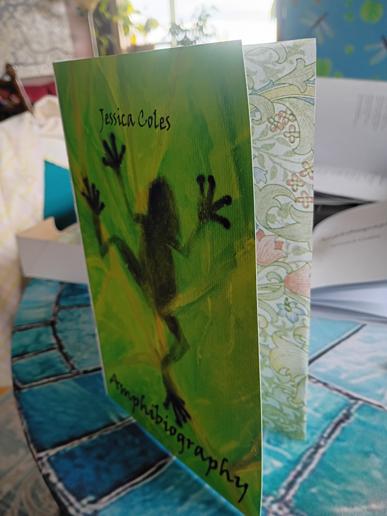
When assembled, the flyleaf can be a contrasting
paper, colour, or a pattern such as this
I’ve enjoyed the campaign to get Big Pond Rumours relaunched so much that I’ve actually shortened the time between chapbook releases. Taking someone’s manuscript and turning it into a chapbook can be a truly uncanny and moving process. It’s rather like conjuring a piece of their heart cast into the future for the author. I work hard to ensure every author enjoys the end result of our collaboration, making them a part in the production of their chapbook so they have their own mystical connection with the chapbook. I had the cover of Jessica’s chapbook printed on heavy cardstock with a glossy finish. The inner pages are blue parchment paper suggesting the water-soaked environment of amphibians which is a focus of Amphibiography. But simply printing the chapbook is not the end of the story by any means. Each copy is folded manually, its chosen flyleaf folded around it, before it’s wrapped in a hand-folded cover. Thee pages are stapled together using a long arm stapler and, in the case of Amphibiography, the hand cut, William Morris-inspired garden flowers on a tissue flyleaf is part of the witchery of esign. They suggest a perfect environment for an amphibian to linger, out of sight until the leaves of the chapbook are opened on the magic of the author’s verse. That’s the part of the augury that inspires my stubborn belief in the important place chapbooks continue to hold in the literary world... at least in Canada.
About the Author
lives in Charlottetown, Newfoundland. Her work appeared in several international publications. Her poetry collection, Stars in the Junkyard, was a finalist for the 2022 International Book Award, and her essay collection, The Name Unspoken, won the 2020 IPPY Award. She is the editor and publisher of the Big Pond Rumours Chapbook Press.


No comments yet. Be the first to comment!