
US-Based Bangladeshi Researcher Leads AI Study Achieving 99.56% Accuracy in Tuberculosis Screening
An international research team led by Md Abedur Rahman has developed an artificial intelligence system that can identify signs of tuberculosis in chest X-ray images with 99.56% accuracy during experimental testing. The findings were published in a scientific journal by Springer Nature.
Ottawa, Canada: Bangladeshi researcher Md Abedur Rahman, affiliated with the University of the Cumberlands in the United States, has led an international team of researchers in developing an artificial intelligence (AI) system that could help healthcare professionals detect tuberculosis (TB) more quickly and efficiently.
The research, titled “An Efficient Channel Attention-Based Lightweight Network for Tuberculosis Screening from Chest X-Ray Images,” was published in Discover Artificial Intelligence, a scientific journal published by Springer Nature, in 2026.
The researchers developed an AI-based system called LiteTBNet-ECA, which analyzes chest X-ray images to identify signs that may indicate tuberculosis. During experimental testing, the system achieved an impressive 99.56% accuracy, demonstrating its potential to support medical screening.
Addressing a Major Global Health Challenge
Tuberculosis is one of the world's major infectious diseases, affecting millions of people each year. The disease primarily attacks the lungs and can spread from person to person through the air.
Early detection is essential for effective treatment and preventing further transmission. However, many healthcare facilities, particularly in developing countries and rural communities, face challenges due to limited access to experienced radiologists and advanced medical technology.
The research team sought to address these challenges by developing an AI system that could analyze chest X-ray images accurately while requiring relatively fewer computing resources.
How the AI Technology Works
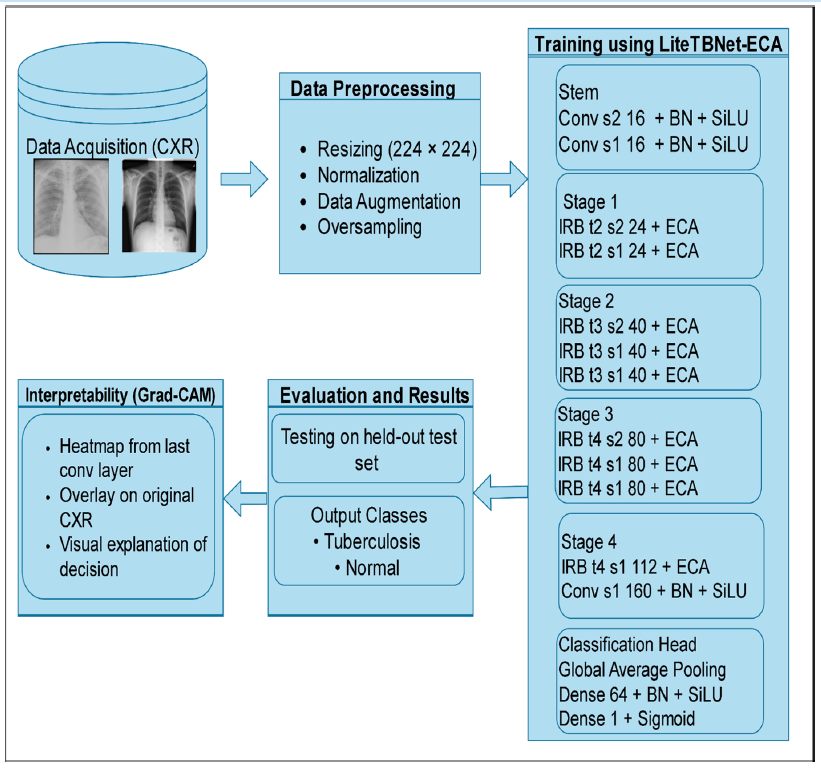
The newly developed LiteTBNet-ECA system uses artificial intelligence to examine chest X-ray images and recognize patterns that may be associated with tuberculosis.
Similar to how a radiologist examines an X-ray for signs of lung abnormalities, the AI model analyzes image features and determines whether the image shows possible signs of tuberculosis.
The researchers trained and evaluated the system using chest X-ray images. In the study's test dataset, the model correctly classified approximately 99.6% of the images.
One of the technology's key advantages is its lightweight design. Unlike many complex AI models that require powerful computing systems, LiteTBNet-ECA was designed to operate with fewer computational resources.
This feature could make the technology particularly valuable for healthcare facilities with limited technical infrastructure.
The system also incorporates techniques that help identify which regions of an X-ray image influenced its predictions, making its results easier to interpret.
Potential Benefits for Healthcare Systems
The researchers believe the technology could eventually support healthcare professionals in identifying possible tuberculosis cases more efficiently.
In hospitals and medical centers where large numbers of chest X-rays must be reviewed, AI-assisted screening could help prioritize patients who may require additional examination.
The technology could also be beneficial in developing countries, including Bangladesh, where some rural healthcare facilities face shortages of specialized medical professionals.
By supporting faster screening and reducing the computational resources required for image analysis, the system could contribute to improving access to healthcare technology.
However, the researchers emphasize that AI-based screening tools are not intended to replace doctors or established diagnostic procedures. Additional clinical testing and validation would be necessary before the technology could be introduced into routine healthcare practice.
Bangladeshi Researcher Leads International Collaboration
The research was led by Md Abedur Rahman, a Bangladeshi technology professional and researcher affiliated with the University of the Cumberlands in the United States.
Rahman has extensive professional experience in software development and information technology, alongside research interests in artificial intelligence, machine learning, and healthcare-related applications.
His research focuses on exploring how modern AI technologies can support medical image analysis, disease screening, and healthcare decision-making.
The study brought together researchers from multiple countries, highlighting the growing importance of international collaboration in addressing global healthcare challenges.
The research team includes Md Abedur Rahman, Md Sharifur Rahman, Md Anwar Hossain, Md Sahid Hossain, Chandan Karmakar, Kallol Chakraborty Shekhor, Kashim Kabir, and Abdul Basit.
The researchers are associated with academic and research institutions in the United States, New Zealand, India, and Ethiopia.
A Promising Step Toward AI-Assisted Healthcare
The study highlights the growing potential of artificial intelligence to support healthcare professionals in identifying diseases and improving medical services.
With its reported 99.56% accuracy during experimental testing and its lightweight design, LiteTBNet-ECA represents a promising development in AI-assisted tuberculosis screening.
Although further validation in real-world clinical settings is needed, the research provides a foundation for developing more accessible and efficient medical screening technologies.
The achievement also highlights the contributions of Bangladeshi researchers to international scientific innovation, particularly in the rapidly developing field of artificial intelligence in healthcare.
Research Publication
Research Title: An Efficient Channel Attention-Based Lightweight Network for Tuberculosis Screening from Chest X-Ray Images
Journal: Discover Artificial Intelligence
Publisher: Springer Nature
Publication Year: 2026
DOI: https://doi.org/10.1007/s44163-026-01337-6
About the Author
Grew up in Bangladesh and studied physics at the University of Dhaka. He enjoys writing on a wide range of topics, exploring both material and spiritual themes that touch on humanity.




No comments yet. Be the first to comment!