
Book Review: Nervous Conditions
I first heard about the writer Tsitsi Dangarembga after her novel This Mournable Body was shortlisted for the 2020 Booker Prize. But this review is about her first novel, Nervous Conditions. The title Nervous Conditions is taken from Jean-Paul Sartre’s introduction to Frantz Fanon’s book The Wretched of the Earth, in which Sartre states: “The status of native is a nervous condition introduced and maintained by the settler among colonized people with their consent.” The novelist Doris Lessing, who had roots in former Rhodesia, now Zimbabwe, commented on the book: “Many good novels written by men have come out of Africa, but few by Black women. This is the novel we have been waiting for…” The Journal of Southern African Studies called it “a powerful indictment of cultural imperialism and a moving insight into the complex and often contradictory choices faced by African women today.”
Tsitsi Dangarembga lives in Zimbabwe. In addition to writing, she works as a scriptwriter and film director. Recently, in July 2020, she was detained in Harare during a peaceful anti-corruption protest. Her conviction was later overturned on appeal, after drawing international criticism.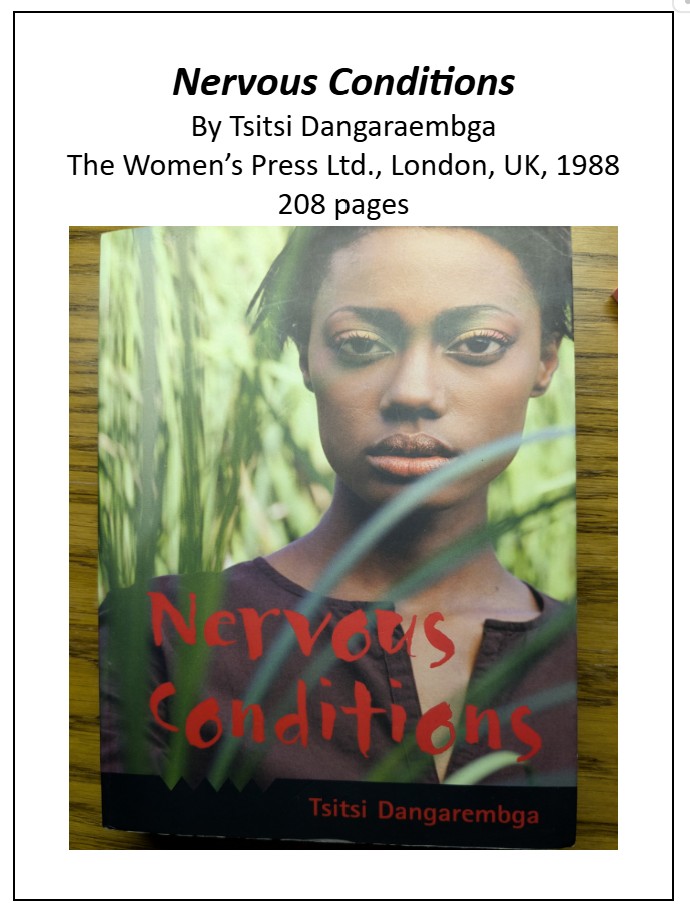
The novel Nervous Conditions is written in the first person point of view, as seen through the eyes of Tambudzai, or Tambu for short. At the start of the book, she is a thirteen-year old girl, growing up in a poor village in colonial Rhodesia in the 1960s.
The place of girls and women in colonial Rhodesia is treated at great length in this novel. A central moral issue of the book is the question of how the postcolonial Western-educated woman and her sisters, daughters, mothers and aunts, wage-earners or wives, together find ways to create meaningful lives.
The novel opens with this sentence: “I was not sorry when my brother died.” We soon find out that Tambu’s uncle is headmaster of a Mission school, where previously Tambu’s brother was getting his education. The death of Tambu’s brother who dies from a disease while away at the Mission school, gives Tambu the break she needed as a “girl” in that culture. The opportunity for her to get an education, with the help of her uncle the headmaster, was only possible because there were no more boys in her family to take her place at the school after her brother died.
The novel does not seem to have been written for the “Western other” reader. Rather, it addresses an African reader, being written in a mix of English and native Shona language, such as for greetings, names of food etc., and without any gloss in English. It treats themes, such as gender equity, racism, colonialism and Western modernity. Consider the following excerpt from the novel:
Today there are fewer white people on the mission. They are called expatriates, not missionaries, and can be seen living in unpainted brick houses. But they are deified in the same way as the missionaries were because they are white so that their coming is still an honour. I am told that whether you are called an expatriate or a missionary depends on how and by whom you were recruited. Although the distinction was told to me by a reliable source, it does not stick in my mind since I have not observed it myself in my dealings with these people.
Dangarembga’s characters are well developed and interesting. The uncle, a stern and authoritative headmaster, his talented wife and their two children, have all just returned from a long stay in England. They had earned Masters degrees. This cultured family stands in sharp contrast to the poverty lived by Tambu’s own mother and her ne'er-do-well father in a rural village. However, Tambu herself changes through living with her western educated relatives at the mission.
The novel is one of the most enjoyable “coming of age” novels I have read, and I strongly recommend it, as well as its sequel This Mournable Body, which follows the story of Tambu as she struggles to make her own way in post independent Zimbabwe.
XXXXX
About the Author
is a member of the editorial board of Ashram.


No comments yet. Be the first to comment!